Generative Engine Optimization (GEO) Checklist: How to Get Cited by ChatGPT, Perplexity & Gemini

Generative Engine Optimization (GEO) is the practice of structuring, sourcing, and formatting web content so large language models (LLMs) and AI search engines—such as ChatGPT Search, Perplexity, and Google AI Overviews—can accurately extract, synthesize, and cite your pages in generated answers.
Unlike traditional search engines that return ten blue links for users to click, generative engines retrieve passages from multiple indexed sources, verify factual consistency, and assemble a direct response with inline source citations. If a page buries its core answer beneath introductory fluff, blocks AI crawlers, or makes unsupported claims, generative models skip it in favor of clearer, verifiable documentation.
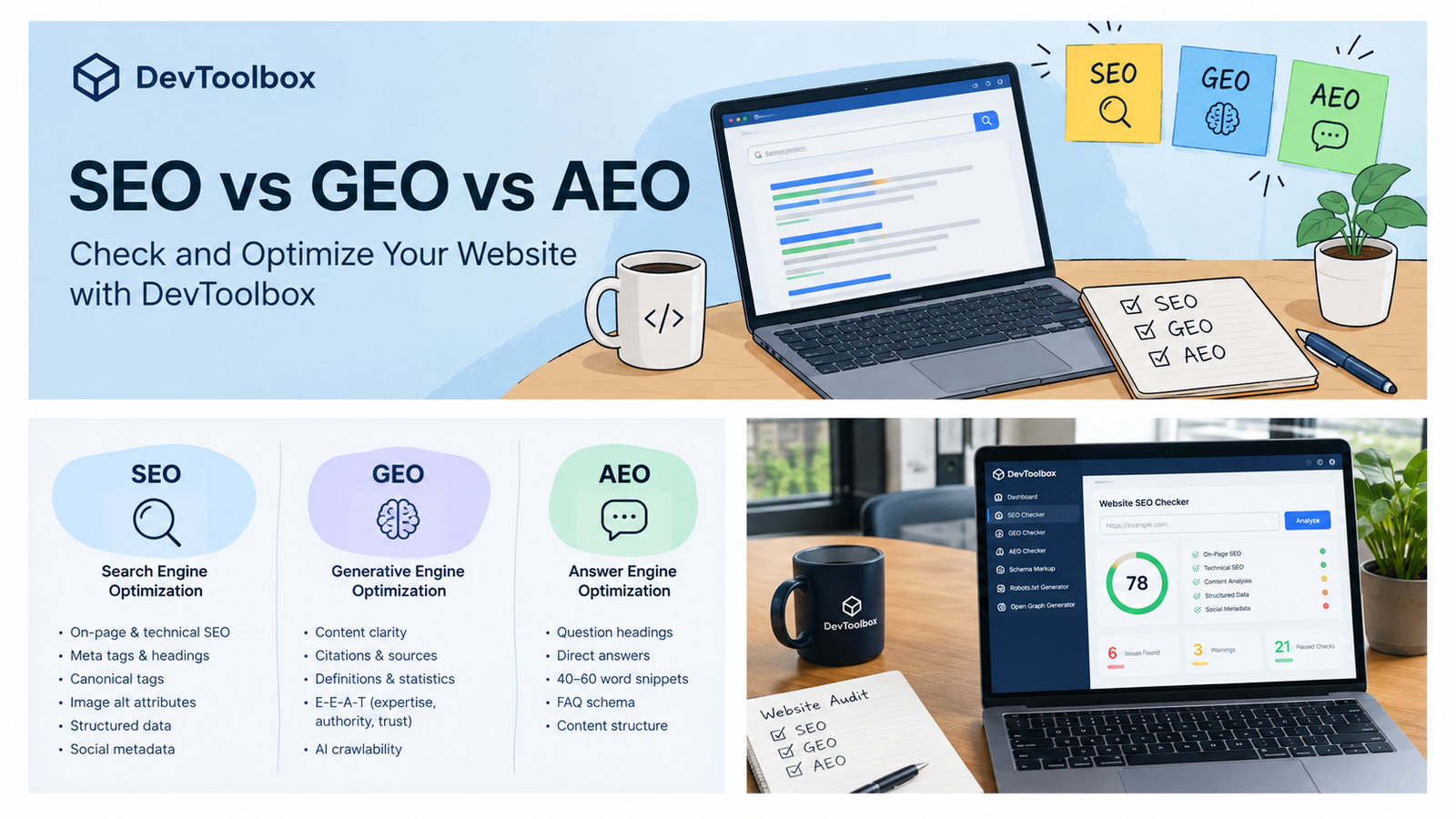
GEO vs. AEO vs. Traditional SEO: Key Differences
While traditional SEO, Answer Engine Optimization (AEO), and Generative Engine Optimization (GEO) overlap technically, each targets a distinct retrieval layer:
Optimization Type | Primary Target System | Core Ranking & Citation Signals |
Traditional SEO | Google & Bing organic SERPs | Backlink authority, title tags, crawlability, Core Web Vitals, keyword relevance |
AEO (Answer Engine Optimization) | Featured Snippets, voice assistants, Google AI Overviews | Question-based headings ( |
GEO (Generative Engine Optimization) | ChatGPT Search, Perplexity, Gemini, Claude | Verifiable citations, original statistics, clear entity definitions, E-E-A-T signals, open AI crawler access |
You can audit how well your existing URLs perform across all three layers using the Free GEO Checker, Free AEO Checker, and Website SEO Checker on DevToolbox.
The Four Pillars of Generative Engine Optimization
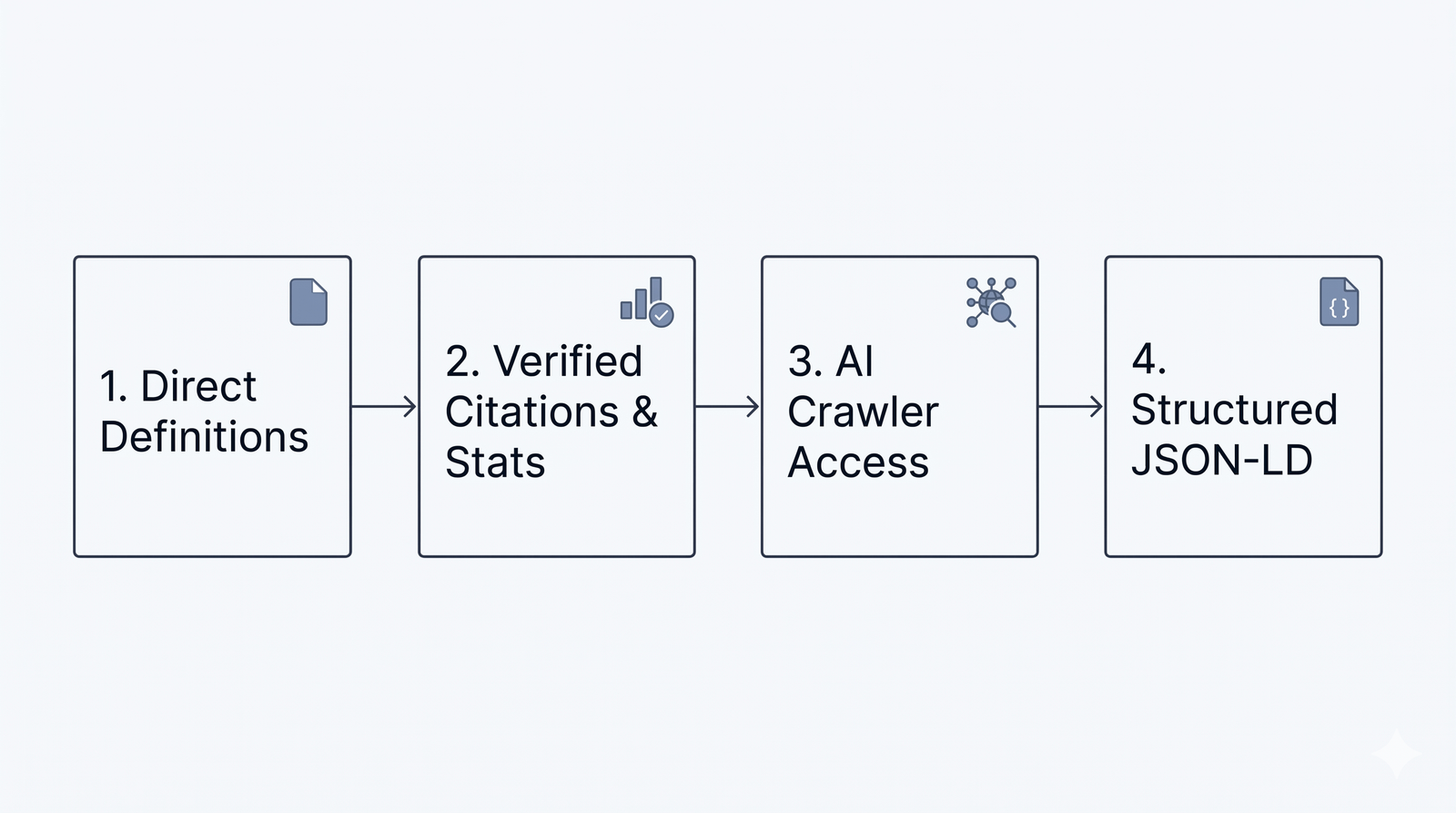
To earn consistent citations inside AI-generated summaries, optimize every technical guide and landing page across four core areas:
1. Lead Every Section with Direct Definitions and Answers
Retrieval-Augmented Generation (RAG) pipelines score passages based on semantic clarity and immediate relevance to the user's prompt.
Place the core answer in the first 1–2 sentences: When using a question or topic heading, define the concept immediately before diving into edge cases or implementation details.
Use unambiguous entity naming: State exact tool names, protocols, HTTP status codes, and version numbers rather than vague pronouns like "this solution" or "it."
Format comparisons with structured tables and lists: LLMs parse HTML
<table>,<ul>, and<ol>elements far more reliably than dense multi-paragraph prose when comparing features or specifications.
2. Back Claims with Verifiable Citations and Concrete Statistics
Generative search engines cross-check factual statements against authoritative primary sources before attaching a citation link.
Cite primary documentation: Link directly to official specifications—such as Google Search Central documentation for crawling rules, Schema.org for structured data types, or OpenAI's crawler documentation for
GPTBotuser-agent behavior—rather than secondary aggregator blogs.Replace vague adjectives with measurable figures: Instead of writing "most websites load slowly," specify exact thresholds such as "Google recommends keeping Largest Contentful Paint (LCP) under 2.5 seconds."
Include original benchmarks or practical examples: Pages containing reproducible code snippets, real configuration files, or firsthand audit findings provide unique information gain that LLMs cannot find in generic rewrites.
3. Verify AI Crawler Access in robots.txt and Server Headers
An LLM cannot cite a page if its retrieval crawler is blocked at the server, CDN, or robots.txt level.
Many security plugins and Web Application Firewalls (WAFs) unintentionally block AI search bots, preventing your site from appearing in real-time web-grounded answers. Verify that your robots.txt explicitly permits search-indexing bots (while still allowing you to block pure model-training scrapers if desired):
Plaintext
User-agent: OAI-SearchBot
Allow: /

User-agent: PerplexityBot
Allow: /

User-agent: Googlebot
Allow: /

Sitemap: https://www.devtoolbox.co.in/sitemap.xml
Generate clean, compliant crawler rules with the DevToolbox Robots.txt Generator.
Inspect your live HTTP status codes and
X-Robots-Tagheaders using the HTTP Header & Redirect Checker to confirm crawlers receive a clean200 OKresponse without redirect chains.Ensure your main content renders in the initial server HTML response rather than relying exclusively on client-side JavaScript execution.
4. Reinforce Entity Context with Valid JSON-LD Structured Data
Structured data gives search engines and AI indexers a machine-readable graph of your page's author, organization, publication date, and question-answer pairs.
Implement
ArticleorBlogPostingschema with accurateauthor,datePublished,dateModified, andpublisherproperties to strengthen Experience, Expertise, Authoritativeness, and Trustworthiness (E-E-A-T) signals.Add
FAQPageschema only when the corresponding questions and answers are visibly rendered on the page.Build and validate your JSON-LD snippets before deployment using the Schema Markup Generator and Schema Markup Validator.
Step-by-Step GEO Audit Workflow
Run a Baseline GEO Audit: Paste your target URL into the Free GEO Checker to evaluate definitions, citation density, E-E-A-T signals, and AI crawlability.
Check Question & Snippet Coverage: Scan the same URL with the Free AEO Checker to spot unanswered user questions or missing structured headings.
Fix Technical Foundations: Confirm canonical URLs, meta descriptions, and internal links pass cleanly inside the Website SEO Checker.
Re-Audit After Deployment: Run the GEO Checker again after updating your page to verify that every structural and citation improvement is detected.
Frequently Asked Questions
How does GEO differ from traditional SEO?
Traditional SEO focuses on ranking URLs in search engine results pages through backlinks, keywords, and technical health, whereas GEO focuses on making factual claims, definitions, and structured data easy for generative AI engines to extract and cite inside synthesized answers.
Which bots control citations in ChatGPT Search and Perplexity?
ChatGPT Search relies primarily on OAI-SearchBot (alongside Bing's index) to retrieve live web citations, while Perplexity uses PerplexityBot. Blocking these user-agents in robots.txt or via firewall rules prevents your pages from being cited in real-time AI answers.
Does adding JSON-LD schema guarantee AI citations?
No. Structured data helps search engines and automated indexers parse entities and relationships accurately, but AI engines prioritize clear explanations, factual accuracy, verifiable external citations, and accessible server-rendered HTML.